
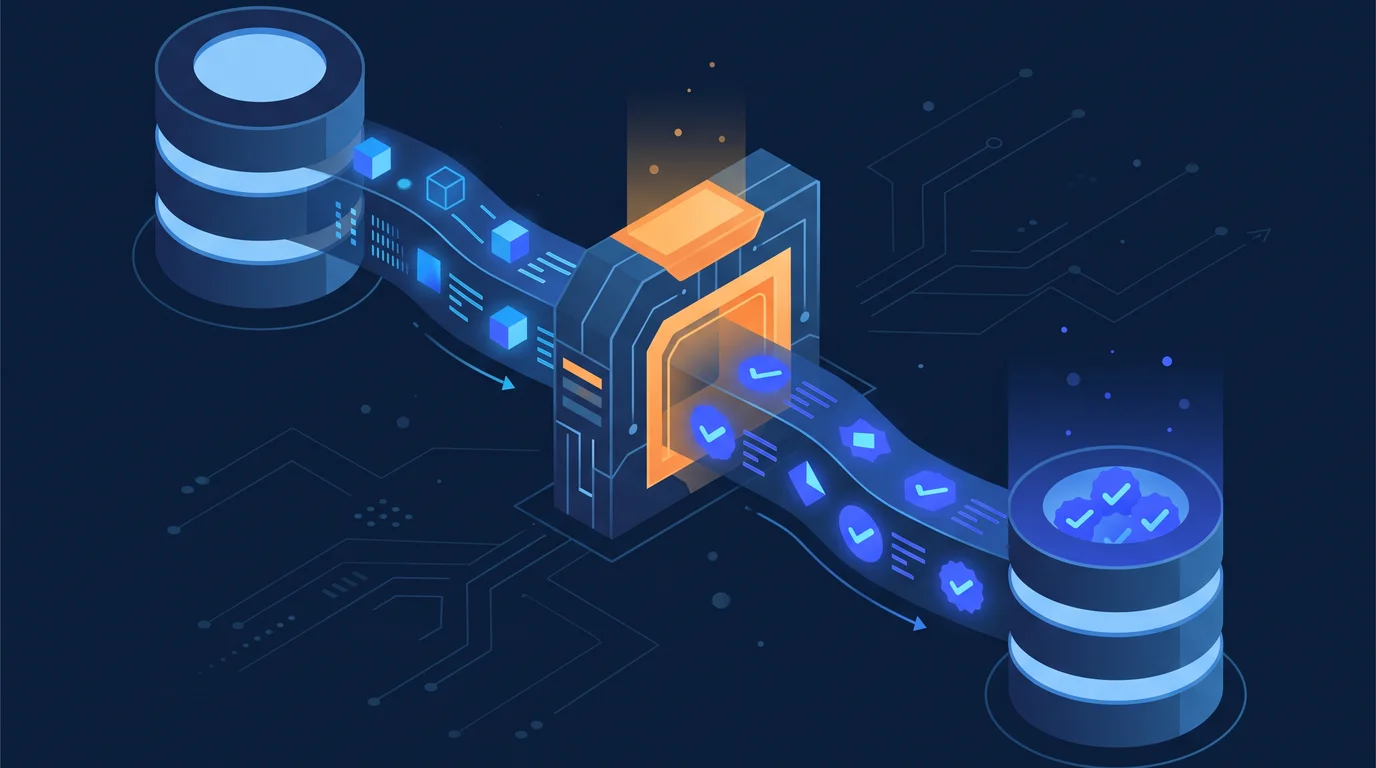
Your new system is ready, but years of accumulated data is trapped in the old database. Schema incompatibilities, different data formats, relational integrity issues, and inconsistent records can make migration projects far more complex than anticipated. A poorly planned migration can result in hard-to-reverse data loss and a new system that launches on a completely non-functional foundation.
Our Solution Approach
At Barlas Dijital, we manage data migration not as a one-time transfer operation but as a controlled process woven with validation steps. Every project begins with an inspection of the source data: data quality, schema structure, relationships, and size analysis are performed. We customize the ETL process with Python or Node.js to match project requirements; a pilot migration is run in full in a test environment first, and the live cutover only takes place once it completes successfully.
Scope & Features
- Database migration — Transitions in any direction between MSSQL, PostgreSQL, MySQL, MongoDB, and SQLite
- Schema transformation — Structural conversion between different data models, field mapping, and type alignment
- Content migration — Transfer of CMS, blog, product catalog, customer records, and form data
- File and media migration — From server file system to S3 or CDN; transfer of large file repositories
- Data cleaning and normalization — Cleaning up duplicate, missing, and inconsistent records; improving data quality
- Pilot migration and validation — Full run in a test environment; data integrity verification in the target system
- Rollback plan — Snapshot and restore preparation for fast rollback if issues arise
- Post-migration validation — Row counts, aggregate values, referential integrity, and relationship checks
Technical Standards
Migration scripts are written in Python (Pandas, SQLAlchemy) or Node.js; operations are idempotent in design and can be re-run. Batch processing and checkpoint mechanisms are used for large datasets; even when migrating millions of rows of data, if the process is interrupted it can resume from where it left off. Every step is logged in detail and anomalies are reported in real time.
Who Is It For?
- Businesses migrating from an old ERP, CRM, or e-commerce platform to a modern system
- Companies with more than a decade of accumulated data who do not want to lose historical data when moving to a new platform
- Technical teams requiring data transfer or consolidation between different database types
Expected Outcomes
- The new system opens fully populated with historical customer records, order history, and content archives
- The system is not taken live until data integrity validation tests pass; zero-tolerance for data loss is the goal
- Dependency on the old system for data is eliminated; the team moves entirely to the new platform
- The migration process is managed transparently; what was done and what was validated at each stage is reported
Frequently Asked Questions
How do we confirm the migration works correctly before going live?
A pilot migration is run in a test environment first, and the live cutover only takes place once that full run completes successfully. In the target system, row counts, aggregate values, referential integrity and relationship checks are performed. The system is not taken live until the data integrity validation tests pass.
Which databases can you migrate between?
Transitions in any direction between MSSQL, PostgreSQL, MySQL, MongoDB and SQLite are in scope. Schema transformation between different data models, field mapping and type alignment are part of the work. Beyond databases, CMS, blog, product catalog, customer records and form data are moved, and files can be transferred from a server file system to S3 or a CDN.
What happens if a transfer of millions of rows is interrupted?
Migration scripts are written to be idempotent, meaning they can be re-run from the start. Batch processing and checkpoint mechanisms are used for large datasets, so even if the process is interrupted it resumes from where it left off. Every step is logged in detail and anomalies are reported in real time.
Can we return to the previous state if something goes wrong?
A rollback plan is prepared at the outset: snapshot and restore preparation is in place for a fast rollback. The process is managed transparently, and what was done and what was validated at each stage is reported.
Clarify This Need
Share the current process, the system you use and the outcome you expect. We will turn it into a practical first scope.
Discuss the SolutionWhatsApp Us